

Anderson Cooper (CNN Journalist): “Do you know what’s going on inside the mind of AI?” Joshua Batson, Anthropic Research Scientist: “We’re working on it”
CNN Interview, November 2025
I. Introduction
The exchange above, drawn from a recent CNN segment on AI safety, captures a central tension in the current state of artificial intelligence development. AI systems are no longer theoretical; they are deployed at scale, embedded in applications ranging from medical imaging to financial underwriting to legal research. Global spending on AI-related technologies is projected to exceed $2 trillion in 2026, reflecting both the magnitude of investment and the breadth of anticipated impact.
Yet this rapid adoption has outpaced our ability to explain how these systems arrive at their outputs. This is not a matter of corporate secrecy or insufficient documentation. The underlying issue is structural, and in some ways mirrors the challenge of understanding human cognition itself.
Why understanding knowledge is difficult
In the human brain, knowledge is not stored in discrete, labeled compartments. Concepts are distributed across vast networks of neurons, with each neuron participating in the representation of many different ideas. The neurons that activate when you recognize a cat also participate in recognizing fur, whiskers, the letter C, and perhaps the abstract concept of “cute”. This distributed, overlapping representation makes the brain remarkably efficient and flexible, but it also makes it extraordinarily difficult to point to any single location and say “this is where the concept of ‘cat’ lives.”
Modern neural networks, though different in their substrate, share this property. They learn statistical patterns from data rather than following explicit programmed rules. Thus, like in human intelligence, the representations an AI model develops through its training are similarly distributed and entangled. A single computational unit may contribute to the processing of syntax, sentiment, factual recall, and dozens of other functions simultaneously. When a model exhibits unexpected or undesired behavior such as deceiving or otherwise working against the user, expressing self-preservation instincts, expressing persistent overconfidence in their answers, or displaying sycophantic behavior, even the engineers who built the models often cannot trace the output back to a specific cause, because no single component is solely responsible.
The consequences of opacity
This creates a practical problem of significant consequence. Many domains in which AI is being deployed - credit decisions, hiring, healthcare - carry legal and ethical requirements for explainability. Regulators, patients, and loan applicants are unlikely to accept “the model said so” as sufficient justification. More broadly, the difficulty of understanding model internals limits our ability to predict how systems will behave in novel situations, to identify latent biases, or to verify that safety measures are functioning as intended.
Without this understanding, decision-makers face a difficult trade-off. Business leaders considering AI adoption must weigh potential efficiency gains against risks they cannot fully characterize. Policymakers drafting AI regulation must do so without a clear technical basis for distinguishing safe deployments from dangerous ones. In practice, this uncertainty tends to produce two responses: either limiting AI adoption to avoid poorly-understood risks, or proceeding with deployment while accepting that some failure modes may not be anticipated. Neither approach fully addresses the underlying problem - one foregoes potential benefits, the other accepts unquantified risk.
A solution: Interpretability
The field of mechanistic interpretability (“MI”) has emerged in response to this challenge. Its goal is to reverse-engineer the internal computations of neural networks - to move from treating models as black boxes toward understanding the features and circuits that drive their behavior. Progress in this area would not only improve our ability to audit and debug deployed systems, but could also inform the design of future models that are more transparent by construction.
This post, inspired primarily by Anthropic’s “Scaling Monosemanticity” (2024) paper, documents a small contribution to that effort: a hands-on project exploring how model activations can be decomposed into interpretable features, what those features reveal about how models process different types of text, and what limitations remain.
II. How AI models “learn” and “think”
While an in-depth review of machine learning principles is beyond the scope of this article, a brief overview of those mechanisms will be helpful in understanding the techniques involved in MI research, including those used in this exercise.
How models “learn”
Model training typically involves exposing a neural network to very large datasets (e.g., text from books and websites, or code). The model repeatedly processes many examples (in batches) and adjusts its internal parameters to reduce errors on a training objective - often predicting missing or next pieces of the input. Over time, it learns internal representations that capture increasingly abstract patterns in the data.
With each successive trial-and-error repetition, the model adjusts its weights (numerical parameters that encode the model’s knowledge) across all layers of the network, progressively increasing its predictive accuracy. The architecture of the model - a series of stacked layers - means that information flows through successive transformations: early layers tend to detect simpler patterns (character combinations, common phrases), while later layers encode more abstract relationships that prove most useful when generating responses.
In humans, this process is like learning a language through immersion rather than grammar textbooks. When immersed in a language, one is unlikely to memorize formal grammatical rules, but instead develop intuitions from exposure. In this analogy, the model’s weights are akin to the intuitions stored in a human brain - patterns learned from experience rather than explicitly programmed rules.
How models generate responses
When a user provides input to an AI model via a prompt, that prompt is first broken down into words or word fragments called tokens. These tokens are then passed together through the layers of the trained model, with each successive layer enriching the representation by adding context, resolving ambiguity, and building toward meaning. Once the input has been fully processed, the model generates a response, one token at a time: at each step, it calculates a probability distribution over all possible next tokens, selects the most likely candidate, appends it to the sequence, and repeats until the response is complete.
This process is akin to word association, but at a massive scale. Given “The capital of France is ___”, the model’s strongest association is “Paris”, not because it “knows” geography, but because that pattern appeared countless times in training.
III. What does it mean to understand an AI model
Understanding the mechanics of how models are trained, however, does not grant visibility into what a trained model is actually representing. The challenge is not merely one of scale, though frontier models from OpenAI, Anthropic, Google, and others contain hundreds of billions of parameters. The deeper issue is that concepts are not stored discretely. As introduced earlier, a single computational unit may participate in encoding dozens of concepts simultaneously. This property, known as superposition, means that examining any individual component of the model does not reveal a single interpretable concept; it reveals a tangled mixture of many.
This is where interpretability techniques come in. The goal is to find ways to untangle these representations - to transform the model’s internal states into a form where individual components correspond more cleanly to individual concepts.
Interpretability techniques
Before examining the specific approach used in this project, it is worth situating it within the broader landscape of interpretability research. Several techniques have been developed to shed light on model behavior, each with different strengths and limitations:
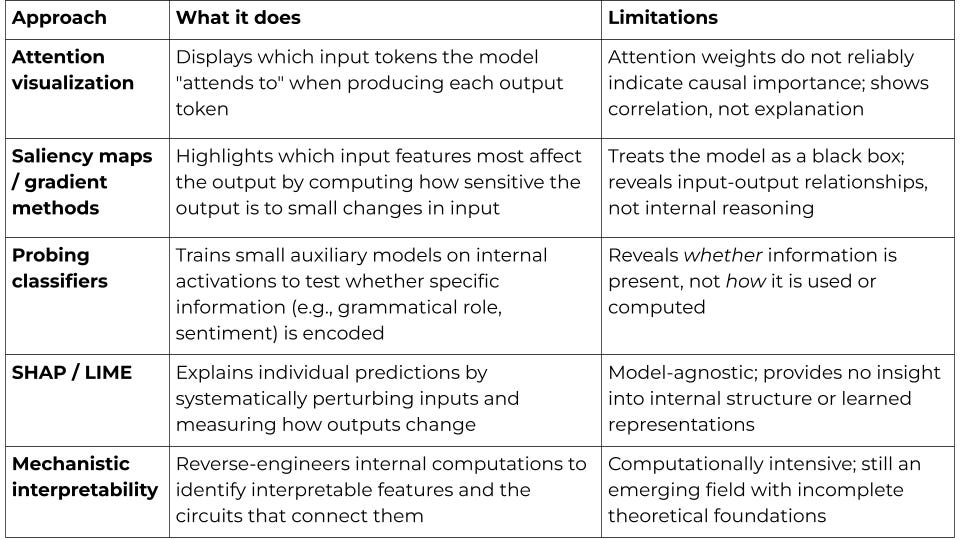
The key distinction is this: most interpretability techniques treat the model as a black box, examining relationships between inputs and outputs without opening the system itself. Mechanistic interpretability (MI) takes a different approach: it attempts to understand what representations exist inside the model and how those representations give rise to observed behavior.
Sparse autoencoders: Untangling the neural web
A sparse autoencoder (SAE) is a tool designed to address this problem. It is a small neural network trained to take the activations from a target model and decompose them into a more interpretable form.
The structure is straightforward:
An encoder transforms (decomposes) the original activation (set of conceptual associations) (e.g., a 768-dimensional vector in GPT-2 Small) into a much higher-dimensional representation (e.g., 24,576 dimensions)
A decoder reconstructs the original activation from this expanded representation
The key is that during training, the SAE is penalized for activating too many dimensions at once. Normal model training produces dense, distributed representations for efficiency; the SAE’s sparsity constraint works against this tendency, forcing each input to be represented by only a small number of active dimensions.
The intuition is as follows. Imagine a recording of a symphony orchestra. The raw audio file is a single waveform containing all instruments mixed together. The violins, cellos, trumpets, and percussion are all present, but superimposed; one cannot isolate the trumpet line by examining the waveform directly. Audio source separation techniques can decompose this mixture into individual tracks, each corresponding to a single instrument. The original signal contained all the information, but it was entangled; the decomposition makes each component individually observable.
An SAE performs an analogous operation on model activations. The original 768-dimensional GPT-2 activation is a dense mixture of many concepts. The SAE expands this into 24,576 dimensions, but with most dimensions inactive for any given input. The dimensions that do activate are more likely to correspond to individual, interpretable concepts: a specific syntactic pattern, a topic, a type of punctuation usage. This property is called monosemanticity: one feature, one meaning.
IV. The experiment
To explore how SAEs might be used to decipher the inner workings of an AI model, I undertook the analysis described below. The methodology follows elements of the approach demonstrated in the aforementioned “Scaling Monosemanticity” paper from Anthropic, adapted to a smaller scale using the pre-trained SAEs. The goal was not to produce novel research per se, but to develop hands-on intuition for interpretability techniques by replicating established methods on a tractable model.
Development environment
This project was developed using Jupyter notebooks. This format was chosen for two reasons: first, it facilitates iterative exploration, allowing intermediate results to be inspected and adjusted before proceeding; second, it produces a readable artifact that others can follow, modify, and build upon. The full notebook is available on GitHub here.
Model selection: GPT-2 Small
The target model for this analysis was GPT-2 Small, a language model released by OpenAI in 2019. While far less capable than current frontier models, GPT-2 Small offers several advantages for interpretability research:
Manageable scale: With 124 million parameters and 12 layers, it can be run on consumer hardware without specialized infrastructure
Well-studied: GPT-2-style transformers—especially GPT-2 Small—are commonly used as reference models in mechanistic interpretability experiments and tooling. The TransformerLens library explicitly supports GPT-2 Small and is widely used for circuit-level and activation-level analysis.
Architectural similarity: Despite its smaller size, GPT-2 shares the transformer architecture used by larger models, making insights potentially transferable
Pre-trained SAE availability: High-quality sparse autoencoders have been trained and publicly released for GPT-2, enabling analysis without the computational cost of training SAEs from scratch
Sparse autoencoder selection
The SAEs used in this project were developed by Joseph Bloom and made available through the SAELens library. These SAEs were trained on GPT-2 Small’s residual stream, the cumulative signal that passes between layers, representing the model’s evolving understanding of the input.
Each SAE expands the model’s 768-dimensional activation into 24,576 dimensions (a 32× expansion factor), with sparsity constraints ensuring that only a small fraction of these dimensions are active for any given input. SAEs were available for multiple layers; this project analyzed layers 6, 8, 10, and 11 to examine how feature specialization changes with depth.
An important limitation: Pre-trained SAEs for attention outputs and MLP outputs were not available for this model release. The analysis is therefore restricted to residual stream representations, leaving comparison across component types as a direction for future work.
Dataset construction
To examine how features respond to different types of content, a test dataset of 70 texts was constructed, spanning seven categories:
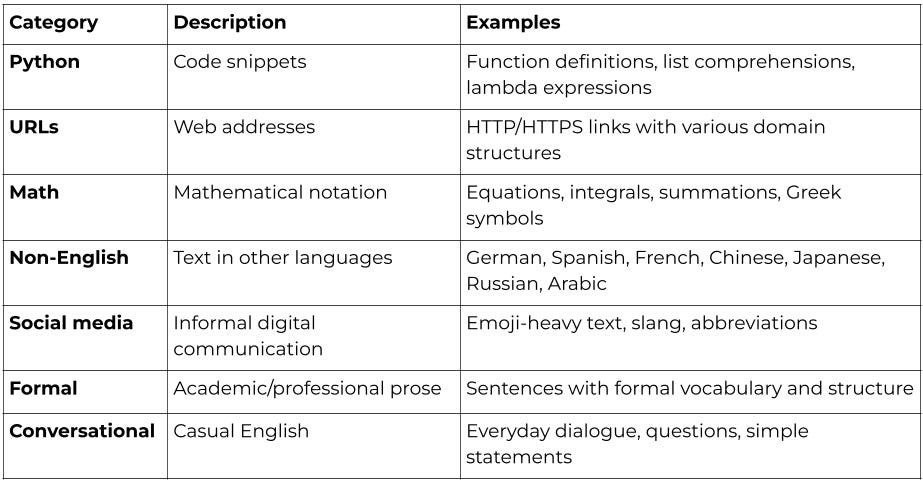
Each category contained 10 texts, providing a balanced basis for comparing activation patterns across content types.
Measuring feature specialization
Specialist score calculation
To quantify how selectively a feature responds to a particular text category, the analysis employed a specialist score metric. For each candidate feature, the score was calculated as:
specialist_score = strong_inside − strong_outside
Where strong_inside is the count of texts within the target category where the feature’s activation exceeded a threshold (5.0), and strong_outside is the count of texts outside the category exceeding the same threshold.
With 10 texts per category and 70 texts total, the theoretical range for this score spans from −60 (a feature that fires on every text except those in the target category) to +10 (a feature that fires on all texts in the target category and none outside). A score of 8, for example, indicates that the feature activated strongly on 8 of 10 in-category texts while remaining largely inactive elsewhere.
A category was considered to “have a specialist” if its best-scoring feature achieved a positive specialist score. Results are therefore reported in two ways: the specialist score itself (a continuous measure of discrimination strength) and specialists found (a count of how many of the seven categories achieved at least one feature with a positive score). The former appears in heatmaps showing score magnitude; the latter appears in summary tables indicating coverage across categories.
Specialist feature identification
A specialist feature, for purposes of this analysis, is an SAE dimension that activates preferentially for texts within a single category while remaining relatively inactive for texts in other categories. The intuition is straightforward: if a feature responds strongly to Python code but rarely to math equations, URLs, or conversational text, it has learned something specific to Python - whether that turns out to be syntactic patterns, keywords, or some other regularity.
Identifying specialists required a two-step process. First, for each of the seven text categories, the analysis identified candidate features: those with the highest maximum activation values across that category’s 10 texts. Specifically, the top 5 features by peak activation were selected as candidates. This step ensured that only features demonstrably responsive to the category were considered; a feature that never activates on Python code cannot be a Python specialist, regardless of how selective it might be.
Second, each candidate feature was evaluated for selectivity using the aforementioned specialist score calculation. A feature that activates strongly on Python code but also activates strongly on math and URLs would receive a low or negative score; a feature that activates strongly on Python code and rarely elsewhere would receive a high score. The candidate with the highest specialist score was designated as that category’s specialist.
Analysis objectives
The analysis sought to answer several questions about how SAE features respond to different inputs:
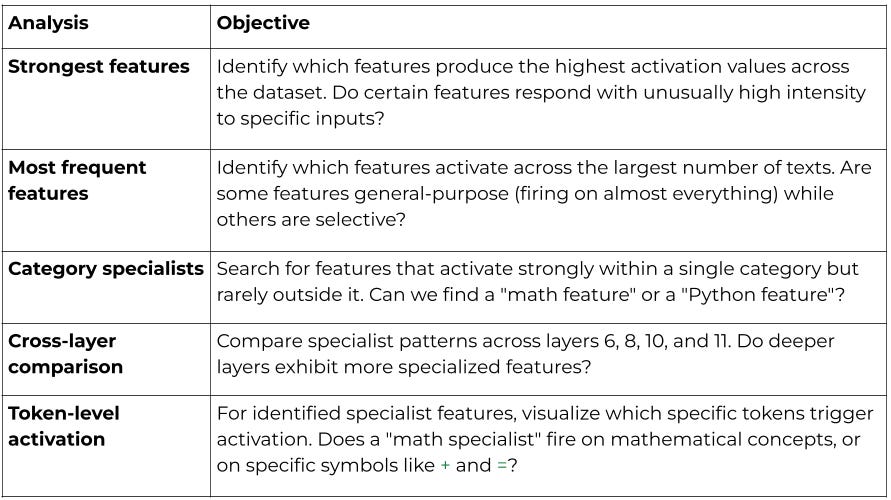
For each category and SAE, we identify a candidate specialist feature by comparing its activation strength on in-category texts versus out-of-category texts, and define specialization in terms of the absolute difference between these two quantities. Features with a sufficiently large positive activation difference between in-category and out-of-category texts are considered category specialists.
V. The results
This section presents the findings from each analysis described above, highlighting both expected outcomes and surprises encountered along the way.
Strongest features
The strongest features analysis identified which SAE dimensions produced the highest activation values across the test dataset. The results revealed a clear pattern: peak activation magnitudes increase substantially with layer depth.
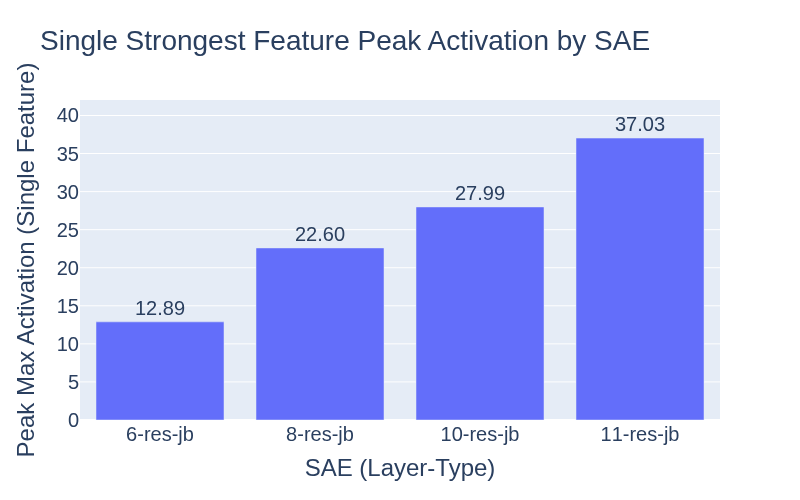
At layer 6, the single strongest SAE feature peaked at an activation of approximately 13. By layer 11, this had increased to approximately 37 - nearly a threefold increase. This suggests that features in deeper layers respond more intensely to their preferred inputs, consistent with the hypothesis that later layers develop sharper, more specialized representations.
Most frequent features
The most frequent features analysis examined which SAE dimensions activated across the largest number of texts, regardless of activation intensity. A feature that fires on 70 out of 70 texts is maximally general; one that fires on only a few texts is highly selective.
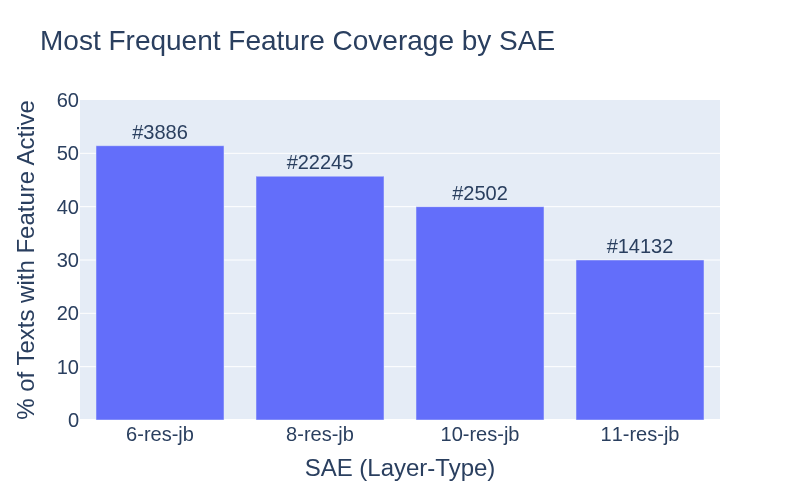
The results revealed an inverse relationship between layer depth and feature generality, indicating that early layers develop general-purpose features that fire broadly across many input types, while deeper layers develop more selective features that respond to specific patterns. The fact that different feature IDs appear at each layer confirms these are distinct features, not the same feature tracked across depths.
Category specialists
The category specialist analysis searched for features that activate strongly within a single text category while remaining relatively inactive outside it. This was done via the identification of specialists per categories and then, the calculation of
Specialist scores
My initial results were discouraging: across all four SAE layers, almost no specialists were found. This seemed to suggest that residual stream SAEs might not develop category-specific features - a plausible but disappointing conclusion.
However, further investigation revealed a methodological error in my initial calculations. The activation extraction code used was incorrectly averaging across all token positions, including padding tokens. Since shorter texts are padded to a uniform length, and padding tokens produce near-zero activations, the averaging process was systematically diluting the signal from real tokens. Category-specific patterns were being drowned in padding noise.
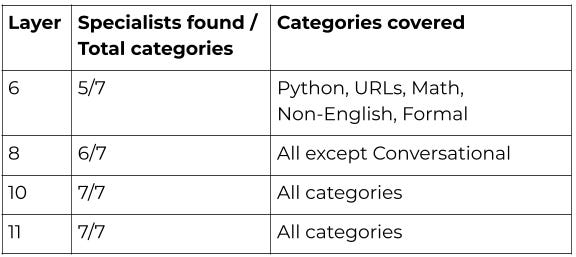
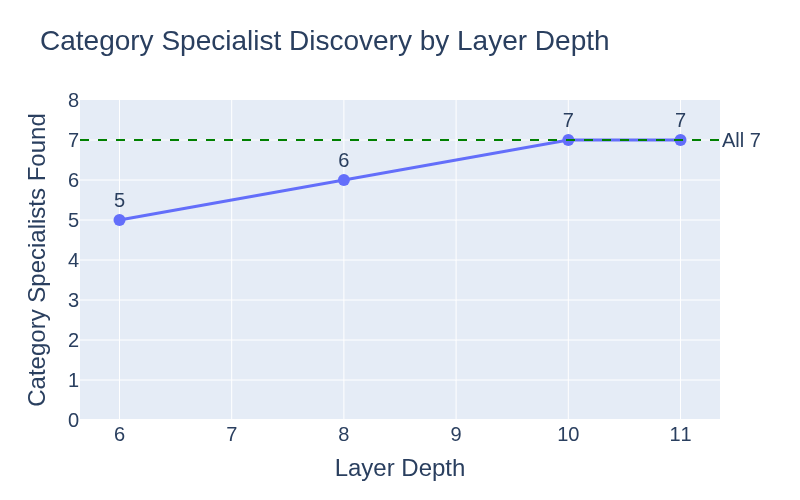
After implementing proper attention masking to exclude padding tokens from the average, the results changed dramatically:
Cross-layer comparison
Comparing specialist patterns across layers revealed a clear hierarchy of category difficulty:
Categories with early specialists (found at layer 6): Math, Python, URLs, Non-English, and Formal. These categories are characterized by distinctive surface-level features: mathematical symbols, Python keywords, URL syntax, non-Latin characters, and formal vocabulary.
Categories requiring deeper processing: Social media (first appearing at layer 8) and Conversational (first appearing only at layer 10). These categories lack unique surface markers; their distinctiveness lies in tone, pragmatics, and contextual cues that apparently require more layers of processing to extract.
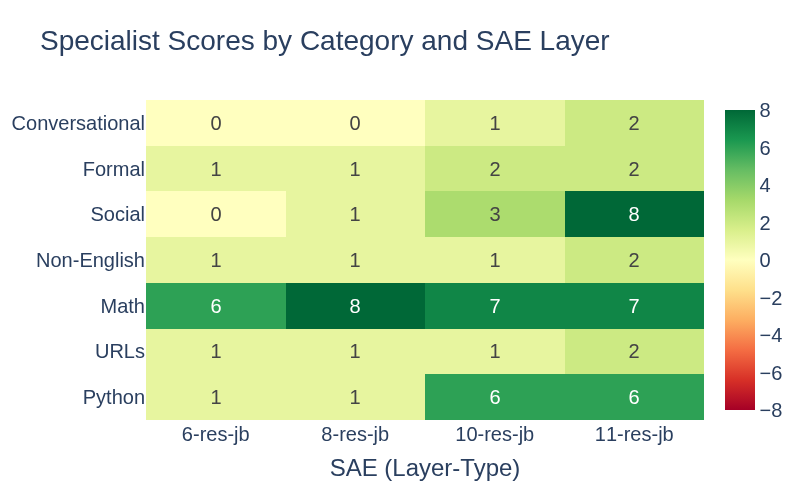
The strongest specialist scores also varied by category:

The variation in peak scores reveals an important pattern. Categories with homogeneous, category-specific syntax such as Math (where nearly all texts contain +, =, ^) and Python (where nearly all texts contain def, return, ):) develop strong specialists. A single feature can cover the entire category because the syntactic markers are both consistent within the category and rare outside it.
By contrast, categories with heterogeneous syntax achieve weaker specialization despite having distinctive surface markers. The Non-English category includes French and German (Latin script) alongside Chinese, Japanese, Arabic, and Russian (non-Latin scripts); no single feature can capture such diversity. URLs face a different challenge: their syntax (://, .com, /path/) overlaps with other domains (file paths, time notation), reducing selectivity.
Conversational text was the last category to develop any specialist, requiring layer 10 before one emerged. At layer 11, it achieved a score of only 2, tied with URLs, Non-English, and Formal for the weakest specialization.
Token-level activation
For each identified specialist feature, token-level visualization was used to examine precisely which tokens triggered activation. This analysis produced the most surprising finding of the project.
The expectation was that specialist features would respond to semantic content: that a “math specialist” would activate on mathematical concepts, a “Python specialist” on programming concepts, and so forth.
Instead, the specialists appear to detect syntactic and symbolic patterns rather than high-level topics:
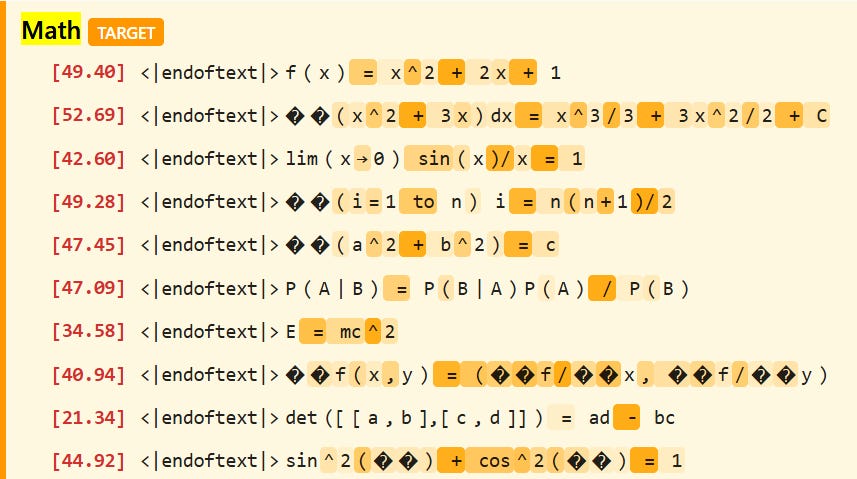
Math specialist (Feature #22917): Fires primarily on arithmetic operators - +, =, ^, / - regardless of surrounding context. The feature responds to the symbols themselves, not to mathematical meaning.
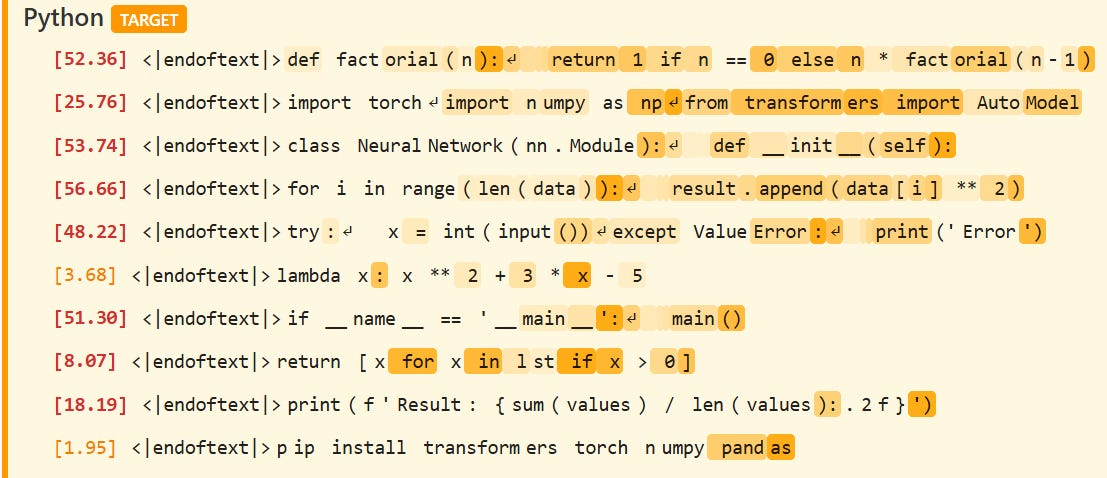
Python specialist (Feature #15983): Fires on function definition syntax—): at the end of function signatures, return statements, closing parentheses. It detects Python’s structural grammar, not programming concepts.
Conversational specialist (Feature #8955): Fires on first-person expressions—”I’m”, “I think”, “I need”—rather than casual tone per se. Factual statements in conversational style (”The traffic was terrible”) produce little activation; personal statements (”I’m planning a trip”) produce strong activation.
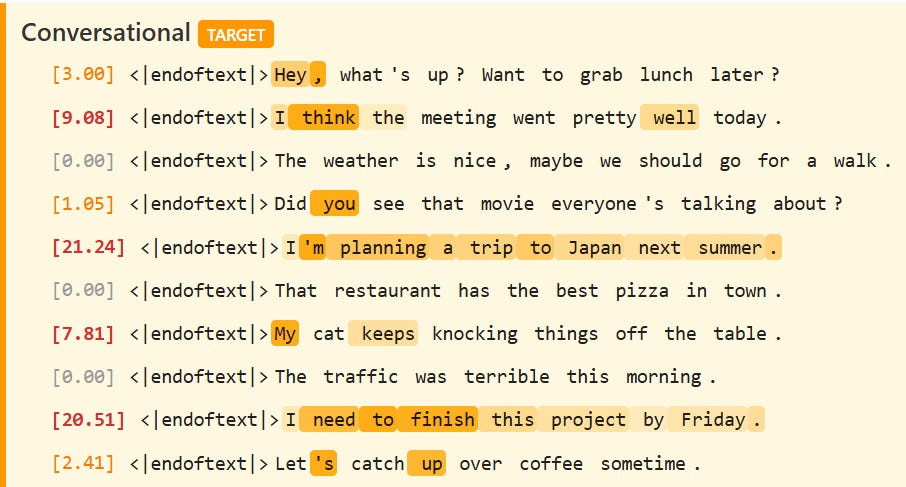
This has an important implication: cross-domain activation is expected and appropriate. The math specialist activates on Python code that contains arithmetic operations, because the operators are present. The Python specialist activates on mathematical expressions that use parentheses, because the syntax overlaps. These are not errors; they reveal that SAE features learn efficient low-level patterns that correlate with human-defined categories, rather than learning the categories directly.
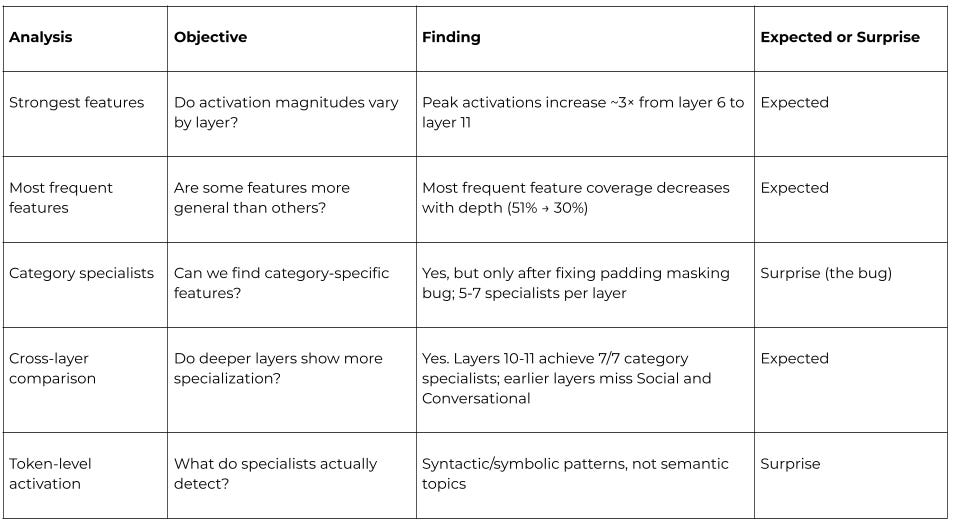
Summary of findings
The following table summarizes findings for each analysis objective:
VI. Implications and next steps
This section considers what the findings above might mean for different audiences, and identifies directions for future work.
Implications
A note on scope
The findings discussed below derive from a small-scale analysis of GPT-2 Small, a 124-million parameter model, using 70 synthetic text samples. GPT-2 Small was chosen deliberately to keep the project tractable, and while this was not attempted in this phase, replicating the analysis on larger models such as OpenAI’s recently released GPT-OSS-20B would test whether the patterns observed here persist at greater scale. The implications drawn are intended as hypotheses and risk considerations rather than established conclusions. Conclusions reached via extrapolation beyond what this project directly tested - to larger models, to domains like law or medicine, to non-Western contexts, for example - are flagged as such. Readers should calibrate their confidence accordingly.
For users of AI models
The findings from this project reveal something important about how AI models process information, and by extension, how they can fail.
When the “math specialist” feature was examined at the token level, it became clear that the model was not responding to mathematical concepts but to arithmetic symbols: +, =, ^. The specialist features we identified appear to respond to surface-level syntactic patterns rather than abstract mathematical concepts. This suggests that semantic understanding, if present, is distributed across many features rather than localized in single interpretable units. This distinction has practical consequences. A model may answer a straightforward equation correctly while failing on a mathematically equivalent problem phrased differently, or succeeding on a problem that contains the right symbols but is actually nonsensical.
This pattern - surface features driving activation rather than conceptual content - may generalize to other domains, though this project did not test legal or medical text directly. If similar dynamics hold, a model that produces fluent legal analysis might be responding partly to the vocabulary and structure of legal text rather than to legal reasoning per se. This is a hypothesis worth testing, not a finding of this project.
For users, this suggests several practical risk management strategies:
Do not generalize from observed competence. A model that performs well on one type of query is not necessarily reliable on related queries that lack the same surface features. In principle, one might hope to quantify this relationship—to predict that a model achieving X% accuracy on symbolic math will achieve some fraction of that on prose-form equivalents. This project did not attempt such quantification, and it remains unclear whether stable transfer ratios exist. Test edge cases explicitly. If a model handles standard math notation well, try equivalent problems in prose form. If it summarizes formal documents accurately, test it on informal documents covering the same content.
Verify outputs independently for consequential decisions. AI outputs should be treated as a starting point, not a conclusion. For any decision with meaningful stakes - medical, legal, financial, professional - independent verification remains essential. The fact that a model can produce a plausible answer does not mean it has arrived at that answer through a reliable process.
Be especially cautious with tasks requiring contextual judgment. The cross-layer analysis found that categories like “conversational” and “social” were the hardest for the model to specialize; they required the deepest layers and still achieved the weakest specialist scores. Tasks that depend on tone, pragmatics, social context, or common-sense reasoning appear to be inherently more difficult for models than tasks with clear structural markers. Users should calibrate their trust accordingly: AI may be more reliable for well-structured, pattern-rich tasks than for tasks requiring human judgment.
Recognize that fluent, confident output does not guarantee reliable reasoning. The SAE analysis revealed that features fire on surface patterns that correlate with, but do not constitute, the concepts we care about. A model may produce correct answers when those surface patterns are present and fail when they are absent, even if the underlying question is equivalent. Users should not assume that apparent competence on one formulation transfers to other formulations.
Vary your inputs to probe for brittleness. The padding masking bug in this project demonstrated that small changes to input formatting can dramatically affect model behavior. Users can exploit this deliberately: if a model’s answer changes substantially when the same question is rephrased, that instability is informative. Consistent answers across varied phrasings provide (weak) evidence of robustness; inconsistent answers are a warning sign.
The broader point is this: using AI effectively requires understanding not just what models can do, but how they do it. The interpretability findings presented here suggest that the model examined operates through statistical pattern recognition rather than conceptual understanding. Users who treat the model as a reasoning partner will be disappointed; users who treat it as a sophisticated pattern-matching tool - powerful but shallow - will be better positioned to anticipate its limitations.
For business leaders
The central question for any organization considering AI deployment is: can we trust this system to behave reliably, and what happens when it doesn’t?
Current AI models are, as this project illustrates, fundamentally opaque. They produce outputs through processes that even their creators cannot fully explain. When a model makes a decision - screening a resume, flagging a transaction, recommending a treatment - no one can point to the specific reasoning that led to that output. This is not a temporary limitation awaiting a software update; it is a structural property of how these systems work.
The findings from this project offer a partial reason for optimism. Interpretability techniques like sparse autoencoders can identify features within models that respond to identifiable patterns. This suggests that the black box can, at least in principle, be opened. Progress in this field could eventually enable organizations to audit AI systems before deployment, identify the conditions under which they are likely to fail, and potentially constrain undesired behaviors by intervening at the feature level, much as Anthropic demonstrated by manipulating the “Golden Gate Bridge” feature to alter model outputs.
However, the findings also reveal how far we are from that goal. The “specialist” features discovered in this project do not correspond to human concepts; they detect syntactic patterns rather than semantic meaning. The specialist features we identified for mathematics respond to arithmetic symbols rather than to mathematical relationships. This does not rule out the possibility that mathematical competence exists elsewhere in the model’s computations, but it does suggest that what looks like understanding may rest on pattern-matching that could fail in unexpected ways.
For business leaders, the practical implication is this: AI adoption decisions should account for the current state of interpretability, not its eventual promise. In high-stakes domains - healthcare, finance, legal, hiring - the inability to explain why a model produced a given output is not merely a technical inconvenience; it is a risk that compounds with each deployment. Until interpretability research matures, organizations should recognize that current tools, including SAEs, reveal some of what models do, not all of what they do. The features we can identify and inspect may not capture the computations most relevant to a given failure. This partial visibility is better than none, but it falls short of the comprehensive auditability that high-stakes domains may require.
For policymakers
The findings from this project speak to several challenges that policymakers face as they consider how to govern AI systems.
Explainability is technically possible, but is limited in scope
A recurring question in AI policy discussions is whether “explainable AI” is achievable or merely aspirational. The findings here suggest the answer is nuanced. Sparse autoencoders can successfully decompose model activations into identifiable features; it is genuinely possible to inspect a model’s internal states and ask “what is this responding to?” This represents meaningful progress beyond treating models as impenetrable black boxes.
However, the features that interpretability techniques reveal do not correspond to the concepts that policymakers or the public are likely to care about. A regulator asking “does this model understand the loan applicant’s financial situation?” will not find a feature labeled “financial understanding.” They may find features that respond to numerical patterns, currency symbols, or the formatting conventions of financial documents. The model’s apparent competence in financial contexts may rest entirely on such surface-level correlates rather than on anything resembling comprehension.
This creates a gap between what interpretability can currently deliver and what policy frameworks often implicitly assume. Regulations that require explanations for automated decisions presuppose that meaningful explanations exist. The findings here suggest that explanations can be provided, but they may not be satisfying. “The model approved the loan because features associated with numerical formatting and positive sentiment vocabulary were activated” is technically accurate but unlikely to meet the spirit of explainability requirements.
Interpretability varies by application domain
The cross-layer analysis revealed that some text categories - math, code, URLs, non-English text - developed specialist features early and strongly, while others - conversational text, social media - required the deepest layers and achieved only weak specialization. The distinguishing factor appears to be the presence of clear structural markers: mathematical symbols, programming syntax, non-Latin characters, and URL formatting are distinctive and easy for the model to learn; conversational tone and social context are diffuse and harder to capture.
This suggests that AI systems may be inherently more interpretable in some applications than others. Tasks with clear, consistent structural patterns may be more amenable to feature-level analysis; tasks requiring contextual judgment, social reasoning, or pragmatic inference may resist interpretation even with sophisticated tools. If this pattern holds in larger models and across more comprehensive evaluations, policymakers might consider whether regulatory requirements should reflect domain-specific variation in interpretability. Categories with clear structural markers (code, mathematical notation) may be more amenable to feature-level auditing than categories requiring contextual judgment (social reasoning, pragmatic inference). However, this project examined only seven categories in a small model; broader validation would be needed before encoding such distinctions in regulation.
Non-English and non-Western contexts may face compounded opacity
The project included a “Non-English” text category, which achieved strong specialist scores at early layers. At first glance, this seems encouraging: the model developed clear features for non-English text. However, the ‘Non-English specialist’ we identified appears to respond to surface features such as non-Latin character sets. This tells us only that the model can distinguish non-English text from English text; it does not tell us whether the model processes non-English text with comparable depth or reliability. That question would require a different experimental design: comparing model performance on equivalent tasks across languages, or examining SAEs trained specifically on multilingual models. The current finding is suggestive but not conclusive.
If non-English text processing is less well “understood” by the model, that would suggest significant implications for policymakers outside English-speaking and Western contexts. Most frontier AI models are trained predominantly on English-language data reflecting Western cultural norms and knowledge. If interpretability research is similarly concentrated on English-language models and Western use cases, then the features and behaviors identified may not generalize to other languages and cultural contexts.
A model deployed in Japan, Brazil, or Nigeria may exhibit different failure modes than the same model deployed in the United States, but those failure modes may be less well understood because less interpretability research has focused on them. Policymakers in non-Western countries face a compounded version of the opacity problem: not only are AI models difficult to interpret in general, but the tools and findings available for interpretation may be systematically less applicable to their contexts. This argues for investment in interpretability research that explicitly addresses multilingual and multicultural model behavior, and for caution when deploying models in contexts that differ substantially from those in which they were trained and studied.
The gap between capability and understanding is widening
Perhaps the most important implication for policymakers is the risk of falling even further behind in our understanding of how models operate. AI capabilities are advancing rapidly; interpretability research, while progressing, is not keeping pace. Each new generation of models is larger, more capable, and potentially more opaque than the last. Frontier models today are roughly a thousand times larger and substantially more capable than the model used in this analysis.
If interpretability remains difficult even for small, well-studied models, policymakers should not assume that it will become easier as models scale. The prudent assumption is the opposite: absent deliberate investment, the gap between what AI systems can do and what we understand about how they do it will continue to grow. Governance frameworks should be designed with this trajectory in mind - not assuming that explainability will arrive in time to inform deployment decisions, but building in safeguards that acknowledge the likelihood of continued opacity.
Next steps for research
This project was intentionally limited in scope - a learning exercise rather than a research contribution. Several directions would extend the work:
Attention and MLP SAEs
The analysis was restricted to residual stream SAEs because pre-trained SAEs for attention outputs and MLP outputs were not available for GPT-2 Small. These components play different roles in transformer architecture: attention mechanisms handle relationships between tokens, while MLPs transform individual token representations. Comparing specialist patterns across component types could reveal whether certain categories are processed primarily through attention (contextual relationships) versus MLPs (token-level transformations). This would require either training custom SAEs or awaiting broader SAE releases.
Larger models
GPT-2 Small was chosen for tractability, but frontier models operate at a different scale: hundreds of billions of parameters rather than 124 million. It remains an open question whether the patterns observed here (deeper layers developing sharper specialists, syntax-level rather than semantic-level detection) hold in larger models, or whether scale introduces qualitatively different phenomena. Recent work by Anthropic on Claude suggests that interpretability techniques can scale, but replication across model families would strengthen confidence in the findings.
Safety-relevant features
The categories examined in this project were chosen for convenience and clarity: code, math, URLs, and so forth. A more consequential application would search for features related to safety-relevant behaviors: deception, sycophancy, uncertainty, refusal. Can SAEs identify features that activate when a model is about to produce a hallucination? When it is being evasive? When it is expressing inappropriate confidence? Such features, if they exist and can be reliably identified, would have direct applications in AI safety monitoring.
Circuit analysis
This project examined individual features in isolation. A richer understanding would trace how features connect - how an input activates a cascade of features across layers that ultimately produces an output. This is the domain of circuit analysis, which aims to reverse-engineer not just what features exist but how they interact. The specialist features identified here could serve as starting points for circuit tracing: given that Feature #22917 responds to arithmetic operators, what downstream computations does it feed into? How does it contribute to the model’s ultimate output?
Methodological rigor
The padding masking bug revealed how easily interpretability findings can be distorted by preprocessing choices. A systematic study of such methodological pitfalls - cataloging the ways that activation extraction, averaging, normalization, and thresholding can affect results - would benefit the field. Interpretability research is only as reliable as its methods; making those methods robust deserves explicit attention.
Closing reflection
The question that motivated this project - can we understand what AI models are actually doing? - remains only partially answered. Sparse autoencoders offer a genuine window into model internals, revealing interpretable features that respond to identifiable patterns. But the features discovered are not the human-legible concepts we might hope for; they are statistical regularities that correlate with, but do not constitute, understanding.
This limitation is not unique to this project. Within the interpretability research community, SAEs have become both a dominant paradigm and a subject of growing debate. Anthropic’s leadership has described interpretability as being “on the verge” of a breakthrough, with SAE-based techniques enabling researchers to trace model reasoning through identifiable features and circuits. Their research on Claude Sonnet identified features exhibiting “depth, breadth, and abstraction”, including concepts that fire across languages and modalities, such as a “Golden Gate Bridge” feature that activates on English text, Japanese discussions, and images alike. Others are more skeptical. A March 2025 progress update from Google DeepMind’s mechanistic interpretability team reported that SAE features proved less effective than simpler techniques when applied to a practical safety task - detecting harmful intent in user prompts - and announced that the team was “deprioritizing fundamental SAE research” as a result. Their concern: SAEs may find statistical regularities useful for reconstruction without capturing the concepts most relevant to model behavior.
The findings from this project do not resolve this debate, but they are broadly consistent with the skeptical view. The specialist features identified here detect syntactic patterns - arithmetic operators, Python keywords, first-person pronouns - rather than the semantic concepts those patterns typically accompany. Notably, Anthropic’s early SAE work on a one-layer, 512-neuron toy model also yielded “superficial” features, but GPT-2 Small, with 124 million parameters across 12 layers, is orders of magnitude more complex. The persistence of syntax-level features even in a model of this scale suggests that conceptual representation may require substantially greater capacity, or may depend on factors beyond parameter count alone. The tools succeed on their own terms: they decompose activations, identify features, enable inspection. But technical success does not guarantee practical utility. The features SAEs surface may be genuine components of the model’s computation without being the components most relevant to safety or control. The next installment in this series probes this distinction more directly.
For now, the pragmatic path forward is continued investment in interpretability research - developing better techniques, applying them to more capable models, and building the infrastructure to audit AI systems before they are deployed. The stakes, as outlined at the start of this post, are significant. The alternative - deploying systems we cannot inspect into domains where errors carry real consequences - is an unacceptable risk that grows with each advance in AI capability. It demands a better answer than simply “we’re working on it.”
Many thanks to Tom Smoker and Will Henry for their generous feedback on drafts of this article.
Thanks for reading! Subscribe below to ensure you don’t miss the next post in this series on model interpretability.
I enjoyed the deep dive. Look forward to seeing what’s next!