

What’s in a name? That which we call a rose
By any other name would smell as sweet
- Shakespeare
This is the second installment of a series of papers exploring basic AI model interpretability techniques. While Part 1 in this series is summarized below, a review of that article will provide helpful context for the analysis below.
I. Executive summary
This analysis builds on Part 1 of this series on mechanistic interpretability via use of sparse autoencoders applied to GPT-2 Small, a relatively simple, open-source model.
The Part 2 findings below broadly support the Part 1 observation that specialist features tend to activate more in response to a prompt’s syntax (surface form) vs. semantics (meaning).
One surprising finding from this analysis is that while specialist features seem to react most acutely to surface form, the overall representation (specialist + non-specialist features) of a prompt seems to group by meaning, implying a mechanism that encodes meaning beyond the use of specialist features.
II. Introduction
As the use of advanced AI models continues to proliferate across nearly all aspects of life, so too does the importance of understanding those models’ behavior. AI models are already deployed at scale in contexts in which tolerance for inaccuracy, bias, or erratic behavior are low or zero, and yet, our understanding of how to manage those behaviors has not kept pace. The result is an economically, competitively and morally unsustainable choice between uncontrolled implementation of AI and self-imposed technological austerity. Only by better understanding model behavior can we responsibly enable the awesome potential of an AI-powered future.
Why models are difficult to understand ... and control
Developing a thorough understanding of how models work to process user input and generate a response remains an incredibly difficult task, even for those who develop those models. The reasons for that difficulty are rooted in how models fundamentally work to process user input.
AI models are not programmed with “rules” in the same way most computer software is built. Generally speaking, there is no person who “tells” a model how to “understand” and respond to user inputs: they contain none of the preordained “if A, then B” logic typically found in computer programs. Instead, a model’s analytical ability is developed organically during the model’s training through a trial-and-error process not entirely unlike how humans learn in response to exposure to new information and feedback. The model observes information, makes an attempt at abstracting a fundamental pattern from that information, applies that pattern in new situations, observes the resulting errors, adjusts that abstraction, and repeats the process until the resulting errors reach some acceptably minimal level.
Also like in a human brain, the connections between concepts within an AI model are incredibly complex. Today’s advanced models are thought to contain trillions of parameters, but the true complexity lies in the dense network of relationships between concepts (e.g. what those parameters encode). As user input is processed through the layers of a model, it is encoded into high-dimensional vectors referred to in aggregate as the model’s internal representation. This internal representation is updated as each layer builds upon those that came before it, updating the values in that vector and in so doing, augmenting the model’s “understanding” of that user input. While this mechanism represents a highly efficient means of processing information and developing pattern recognition, a given vector’s many dimensions each link to many, often unrelated, concepts (a concept known as polysemanticity), making the vector impossible for humans to read and understand directly.
Implications for AI safety
The complexity associated with polysemantic vectors makes it incredibly difficult to understand how model outputs are formulated, which in turn inhibits our ability to control those outputs. Lacking ways to control model output directly, most of today’s AI safety techniques - reinforcement learning from human feedback, content filters, constitutional constraints - try to affect model responses from the outside, shaping behavior without fully understanding or controlling its origins.
These attempts, while vastly better than nothing, are inefficient at best and ineffective at worst. Even with the aforementioned safety techniques in place (or sometimes, because of these measures), today’s most advanced AI models suffer from a wide array of faults including under- and overconfidence, sycophancy, bias, bias overcorrection, and of course, inaccuracy. This limits the adoption of AI models in the contexts in which their use promises the greatest societal good: medicine, law, and governance, to name but a few. In order to fully realize the transformative potential of AI on the human experience - the elimination of disease, the proliferation of peace and improved governance, a life less centered on toil, etc. - we need to control these machines of (supposedly) loving grace.
III. Background
Mechanistic interpretability and sparse autoencoders
Mechanistic interpretability (”MI”) is a field within machine learning research that takes a novel approach to AI safety: rather than shaping behavior from the outside, it looks inside a model, attempting to simplify and understand the conceptual linkages that underpin the model’s behavior. By disaggregating a model’s polysemantic internal representations, we can begin to understand the associations a model makes between concepts and by extension, the model’s overall reasoning process.
The primary tool for this work is the sparse autoencoder (SAE). A model’s internal representations are dense and entangled: many patterns encoded simultaneously, blended together like white light that appears uniform but actually contains every color of the spectrum. An SAE acts as a prism, separating this apparently uniform signal into distinct, interpretable concepts known as “features” - the hidden colors, so to speak. Each feature corresponds to some pattern the model has learned to detect.
By examining which features activate strongly for a given input, researchers can begin to see what the model is responding to internally. Part 1 in this series explored this technique in depth; here, it suffices to understand that SAEs offer a window - however imperfect - into the model’s internal organization. To what degree the features SAEs reveal represent genuine concepts or merely surface-level patterns is precisely what this installment investigates.
Part 1 findings: A review
Part 1 in this series on MI sought to understand if the basic application of SAEs to GPT-2 Small (a relatively simple model selected for its small size and the availability of pretrained residual stream SAEs) would allow for a better understanding of how that model’s features react to samples of input text. A summary of those findings is shown in Figure 1 below.
In short, the Part 1 analysis found that the application of SAEs illustrated typical model behavior as implied by machine learning principles, such as the changes in representations at various layers within the model and progressively greater abstraction as information passed through subsequent layers of the model.
While not the primary focus of the Part 1 analysis, it was observed that features seemed to react more strongly to a sample text’s form, as opposed to that text’s meaning. If this behavior was genuine and pervasive, it implied that models were acting “superficially”, performing pattern recognition based primarily on the specific format of a text sample, and thus did not “understand” the meaning of that text sample. This implication, by virtue of its surprise and its far-reaching implications for model behavior, served as the basis for this Part 2 analysis.
IV. Experimental hypothesis and design
Objective
The fundamental objective of this Part 2 analysis is to better understand how a model treats differences in surface form vs. meaning as it relates to user-inputted text. For example, if a model truly “understands” mathematics, we might expect it to treat “2 + 2” and “two plus two” as fundamentally the same thing: different surface representations of an identical concept. But if the model treats them differently internally, it suggests the model may be reacting to the symbols themselves rather than the ideas they represent.
This distinction has practical consequences. If models process surface patterns rather than underlying concepts, their failures become harder to predict: a model might perform well on standardly-formatted inputs while failing unexpectedly on semantically equivalent but syntactically unusual ones. Understanding whether apparent competence will generalize, or whether it depends on the presence of familiar surface markers, is essential for calibrating trust in AI systems.
Hypothesis
This Part 2 analysis tests the question of how models treat form vs. meaning by comparing how GPT-2 Small’s internal representations respond to semantically equivalent inputs presented in different surface forms. The four hypotheses tested in this analysis are shown in Figure 2 below.
Each hypothesis listed above targets a different level of analysis from individual features (H1) to feature groups (H2) to full representational geometry (H3) to observable behavior (H4). This multi-level approach ensures that findings are not artifacts of any single analytical choice and seeks to provide a more holistic view of the model’s behavior.
Use of matched-pair text samples
Testing whether the model treats semantically equivalent inputs the same way internally requires inputs that are semantically equivalent but differ in surface form. This analysis uses a matched-pairs design: content is held constant while surface form varies systematically.
For each of seven topic categories, multiple surface forms were created that express the same or similar content with different formatting, vocabulary, or stylistic conventions. If the Part 1 specialists respond to semantic concepts, they should activate similarly across form variations. For example, “2 + 2” and “two plus two” should look alike internally, as should Python code and its pseudocode equivalent. If specialists respond primarily to syntax, we should see dramatic activation differences between forms: symbolic math diverging from verbal, actual code diverging from pseudocode, emoji-dense text diverging from plain.
This design also predicts where we should see the largest divergence. Categories with distinctive syntactic markers (math symbols, Python keywords, emoji) should show greater form-sensitivity than categories distinguished primarily by tone or register (formal vs. conversational), where the surface differences are subtler. If form-sensitivity appears across all categories, it suggests a fundamental property of how the model represents information rather than an artifact of any particular domain. A sample of topic and form combinations is shown below in Figure 3.
The complete dataset, including all matched pairs, is contained within the Part 2 Jupyter notebook available via this project’s GitHub repository.
A note on mathematical complexity
The introduction used “2 + 2” versus “two plus two” to illustrate the core question, and this analysis does test such simple expressions. However, the math specialist features identified in Part 1 respond most strongly to syntactic markers characteristic of complex mathematical notation: integrals (∫), summations (∑), Greek letters (θ, π), exponents (^), and function notation. Simple arithmetic lacks these markers and produces weaker specialist activation.
The test dataset therefore includes both simple and complex mathematical expressions. The complex expressions - derivatives, integrals, summations, and similar - match the style of the Part 1 baseline and provide a stronger test of the form-sensitivity hypothesis.
A note on the Non-English category
The Non-English category in the matched pairs sample texts is structured differently from the others. While most categories test different surface forms of identical content (e.g., “2+2” vs. “two plus two” express the same mathematical statement), the Non-English category tests different languages expressing similar but not identical content. “Hola, ¿cómo estás?” and “Bonjour, comment ça va?” are semantically equivalent greetings, but they are not translations of a single source text.
This design tests a related but distinct question: does the “Non-English specialist” identified in Part 1 respond to non-English text in general, or does it distinguish between language families? If the specialist fires equally on Spanish, French, and German, it suggests detection of “not English” rather than any specific linguistic property. If activation patterns differ by language, it may indicate sensitivity to language-specific features such as character patterns, diacritics, or vocabulary.
Methodological refinements from Part 1
Part 2 incorporated two methodological improvements discovered during analysis.
Part 1 averaged GPT-2’s raw activation vectors across tokens before passing them through the SAE. Part 2 instead encodes each token through the SAE first, then averages the resulting feature vectors (”encode-then-mean” rather than “average-then-encode”). This refinement better matches the SAE’s training and intended use and as a result, produced stronger differentiation between categories: within-topic similarity improved from 0.406 to 0.503, and the gap between within-topic and cross-topic similarity improved from 0.288 to 0.366. The improved methodology was applied retroactively to the Part 1 baseline to ensure fair comparison between Part 1 and Part 2. Furthermore, as with Part 1, all analyses in this article are limited to representations expressed in the residual stream; the results may not generalize to attention outputs or MLP activations, which may encode information in qualitatively different ways.
Second, the SAEs used in this analysis work better on some types of text than others, a concept encapsulated and quantified by measuring reconstruction error for each topic + form pairing. Because the SAE was trained primarily on natural English text, it captures Conversational and Formal text most faithfully. More specialized content - complex mathematical notation, Python code, and Non-English text - falls further outside the SAE’s training distribution, making the analysis of those categories less precise, as evidenced by higher reconstruction errors for those categories (again visible via the notebook available on the project’s GitHub repository). This suggests that findings in Conversational and Formal categories are therefore most reliable; findings in Math, Python, and Non-English categories should be interpreted with appropriate caution, though the core patterns (form-sensitivity, topic clustering) appeared consistently across all categories.
V. Results
Summary of results
The Part 2 analysis produced evidence generally supportive of the observations made in Part 1: that GPT-2 Small’s specialist features respond primarily to surface form rather than semantic content (i.e. “meaning”).
However, these results came with an important nuance. While the features most active in response to a given user input are highly form-sensitive (H1, H2 supported), when one looks at all the features activated by a given user input, including those features activated at more modest levels, the model’s overall activation pattern organizes by topic rather than by form (contrary to H3’s prediction). This critical distinction hints at a potential mechanism by which a model can simultaneously be sensitive to the form of an input while remaining “cognizant” of that input’s meaning.
Finally, the behavioral test (H4) proved inconclusive, as GPT-2 Small lacks mathematical reasoning capability entirely, achieving near-zero accuracy regardless of surface form.
These results are summarized in Figure 4 below.
H1: Specialist features will show significantly higher activation for symbolic forms than verbal/prose forms of the same expression.
Evaluation of H1 involved two complementary analyses that sought to more rigorously evaluate the Part 1 observation that the model seemed to pay particular attention to a text sample’s surface form - the unique symbols or notation used in the text sample - as opposed to that text sample’s actual meaning. While that Part 1 behavior was most acutely visible in the math samples used in that text, its applicability spoke to a potentially broader pattern of behavior wherein the model developed only a superficial representation of the user-inputted text, potentially limiting its usefulness in generating useful responses to user input.
Test 1: Cross-application of Part 1 specialists to Part 2 text
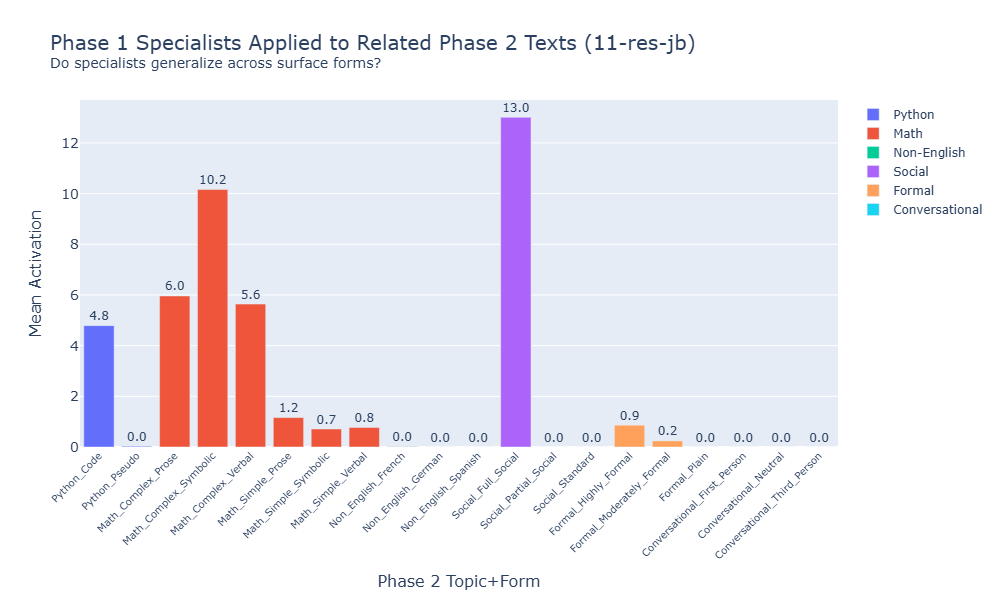
The first of two tests used to test the model’s behavior with regards to surface form versus meaning was the application of the specialists identified in the Part 1 analysis to the far more extensive Part 2 pairwise texts listed above. Observing the levels of activation in those Part 1 specialists when exposed to the various surface forms of Part 2 sample texts (”symbolic”, “verbal” and “prose” math, for example), it became clear that the Part 1 specialists generally responded to surface form vs. meaning, but this behavior was not uniform across the text samples tested. For example, while the Part 1 Python, Social, and Formal language specialists responded more strongly to those topics’ more symbolic surface forms, the Part 1 Math specialist responded strongly across all surface forms of complex math, suggesting this specialist was more associated with complex mathematical logic, as opposed to only mathematical symbology. Examples of that behavior are shown in figure 5 below:
Figure 5: Application of Part 1 features against Part 2 text
Test 2: Measuring activation levels and surface-form specificity of Part 2 specialists
Whereas Test 1 applied Part 1 specialists to their analogous text samples from Part 2, Test 2 derived new specialists for each topic + form combination in Part 2 and then measured those specialists’ activation and form-specificity.
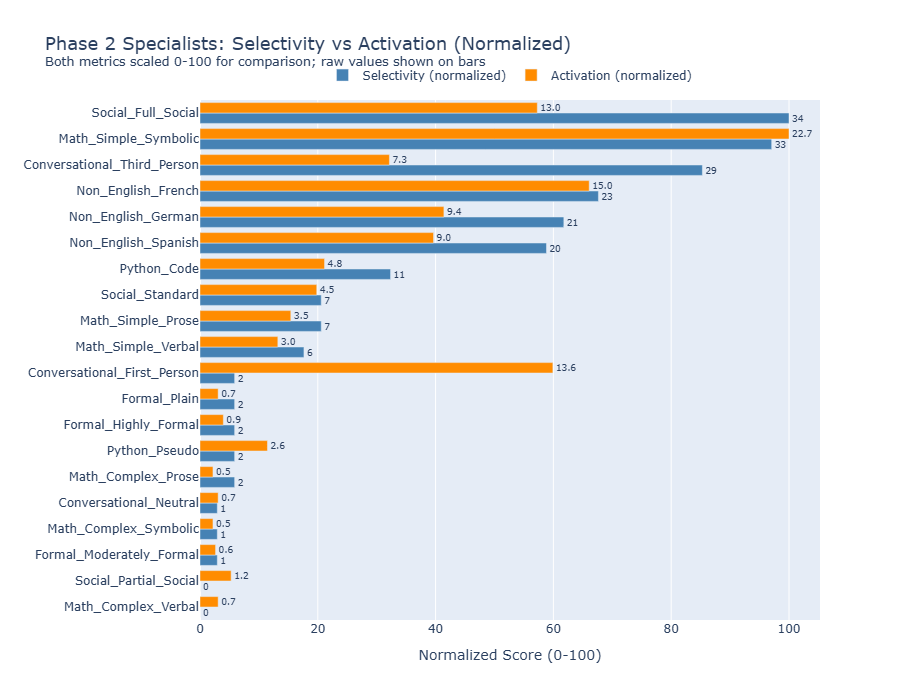
For each newly-derived Part 2 specialist, the analysis calculated activation in the same manner done in Test 1. That feature’s selectivity was then scored using the following mechanism, wherein a high specialist score means the feature in question fires frequently and almost exclusively for a given topic + form combination:
Specialist Score = (strong activations inside category) − (strong activations outside category)
Wherein:
“Strong activations inside” = count of texts within the target it’s applicability spoke to a potentially broader pattern
“Strong activations outside” = count of texts outside the target category where the feature exceeds that same threshold
By focusing a feature’s specialist score on activations related to the same form and penalizing that score for activations in response to other forms of the same message, high scores indicate that feature’s focus on that specific form, as opposed to the underlying meaning common across the various surface forms of the same message.
The results of this combined analysis suggest that specialist activation seems to be driven largely by form vs. meaning, as shown in the figure below, wherein forms that used unique characters (social_full_social, math_symbolic, and non-english texts) showed much higher activation levels and specialist scores, compared to more plain-text examples. A summary of these results is shown in Figure 6.
Figure 6: Activation and selectivity of Part 2-specific specialist features
H2: Different surface forms will activate largely distinct feature populations, with natural language forms sharing more overlap with each other than with symbolic notation.
While H1 examines how individual specialist features respond to different surface forms, H2 takes a broader view: when the model processes different surface forms of the same content, does it activate the same features or different ones? If the model truly groups representations by underlying meaning, we might expect similar content to activate similar features regardless of how that content is expressed. Conversely, if the model is primarily responding to surface syntax, different forms should activate largely distinct feature populations.
Methodology
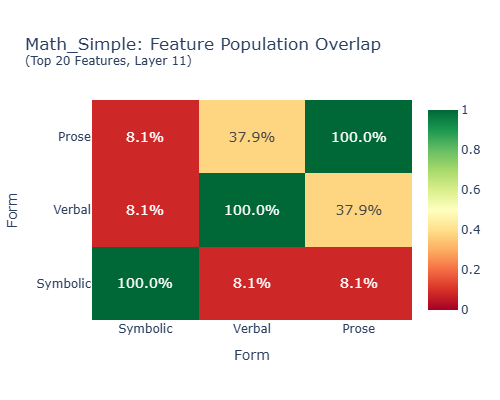
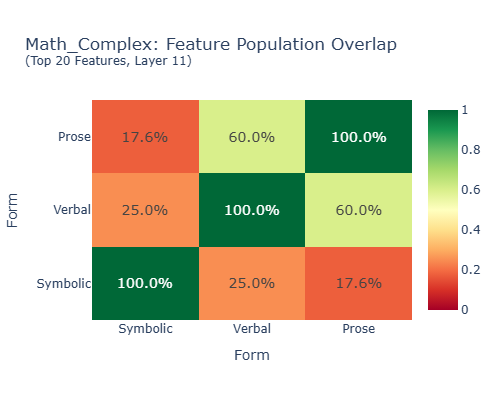
For each topic + form combination, the analysis identified the top 20 most strongly activated features (by mean activation). The overlap between these feature sets was then measured using Jaccard similarity: the ratio of shared features to total unique features across both sets. A Jaccard similarity of 100% would indicate identical feature populations; 0% would indicate completely distinct populations.
Results
The results strongly support H2: different surface forms activate largely distinct feature populations, with natural language forms sharing more features with each other than either shares with symbolic notation.
The pattern is most visible in the mathematical categories, as shown in Figure 7. For simple math, symbolic notation shares only 8% of its top features with verbal form, and 8% with prose form. However, verbal and prose forms (both natural language representations) share 38% of their top features with each other. Complex math shows a similar but less extreme pattern: symbolic↔verbal overlap is 25%, symbolic↔prose is 18%, but verbal↔prose overlap reaches 60%.
Figure 7: Part 2 math feature overlap
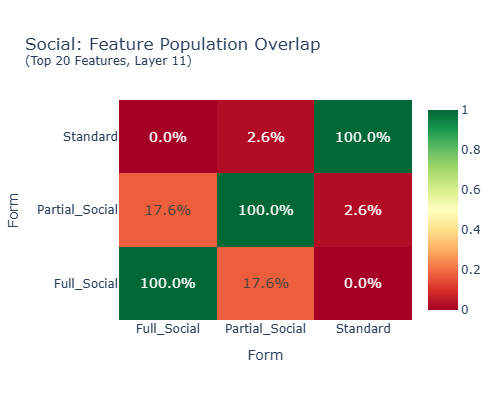
The Social category, shown in Figure 8, showed the most extreme divergence: emoji-laden text (Full_Social) shared 0% of its top features with standard English expressing the same sentiment. Even within the Formal category where surface differences are more subtle, the highly formal register shared only 14% of features with plain English.
Figure 8: Part 2 social (texting shorthand w/ emojis) feature overlap
This pattern of low overlap with symbolic forms, higher overlap between natural language variants, appeared consistently across categories, as is shown in Figure 9.
Figure 9: Comparison of overlap between symbolic and natural language pairs
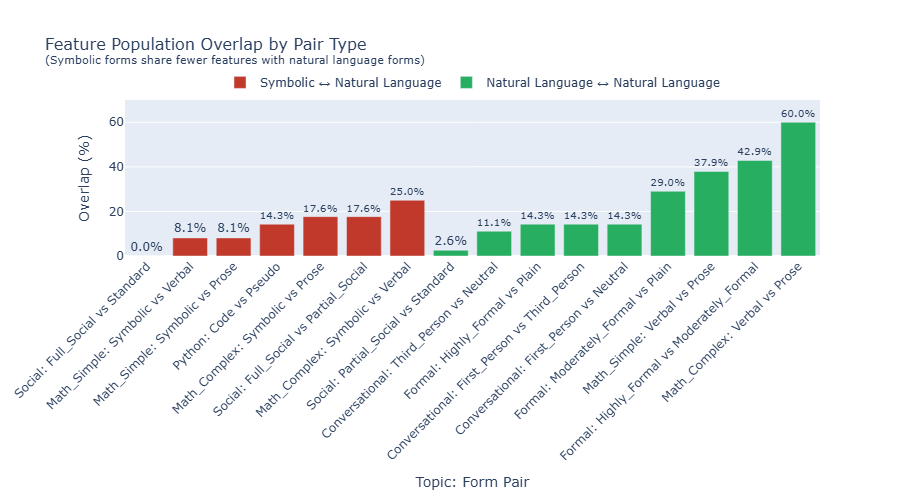
These results reinforce the H1 findings from a different angle. H1 showed that individual specialist features are form-sensitive; H2 shows that entire feature populations diverge based on surface form. The model doesn’t merely weight features differently across forms, it engages largely distinct feature subsets depending on how content is expressed.
The gradient from symbolic to natural language forms is particularly informative. Symbolic notation (mathematical symbols, code syntax, emoji) activates feature populations that are largely distinct from those activated by natural language. But natural language variants - verbal and prose descriptions - share substantially more features with each other, suggesting the model recognizes some kinship between these surface forms even when it treats symbolic notation as fundamentally different.
H3: Cosine similarity between expressions in the same form (different concepts) will exceed similarity between the same concept in different forms.
While H1 and H2 examined which features activate most acutely in response to sample text and whether those feature sets overlap, H3 asks a more fundamental question about the model’s representational geometry: when we consider the entire activation pattern across all 24,576 features, do representations organize by surface form or by semantic topic? If H3 is supported, two different mathematical expressions written symbolically (e.g., “2+2” and “sin²θ”) would be more similar to each other than the same expression written in different forms (e.g., “2+2” and “two plus two”). This would suggest that surface form dominates the model’s internal organization.
Methodology
For each topic + form combination, the analysis computed a mean activation vector by averaging the SAE feature activations across all texts of that type. Cosine similarity was then calculated between all pairs of these mean vectors, producing a similarity matrix that reveals how the model’s representations relate to one another.
Three types of similarity were compared:
Within-topic similarity: Pairs sharing the same topic but different forms (e.g., Math_Symbolic vs. Math_Verbal)
Cross-topic similarity: Pairs with different topics (e.g., Math_Symbolic vs. Python_Code)
Within-form similarity: Pairs sharing similar form types across different topics (e.g., all “Symbolic” forms)
Because pairwise similarities are not statistically independent (violating t-test assumptions), a permutation test with 10,000 iterations was used to assess significance.
Results
The results do not support H3; in fact, they reveal the opposite pattern. Representations cluster strongly by topic, not by surface form. These results are summarized in Figure 10.
The within-topic similarity (0.503) is nearly four times higher than cross-topic similarity (0.137), and more than double the within-form similarity (0.239). This means that “2+2” is far more similar to “two plus two” in the model’s representational space than it is to “sin²θ”—despite sharing symbolic notation with the latter.
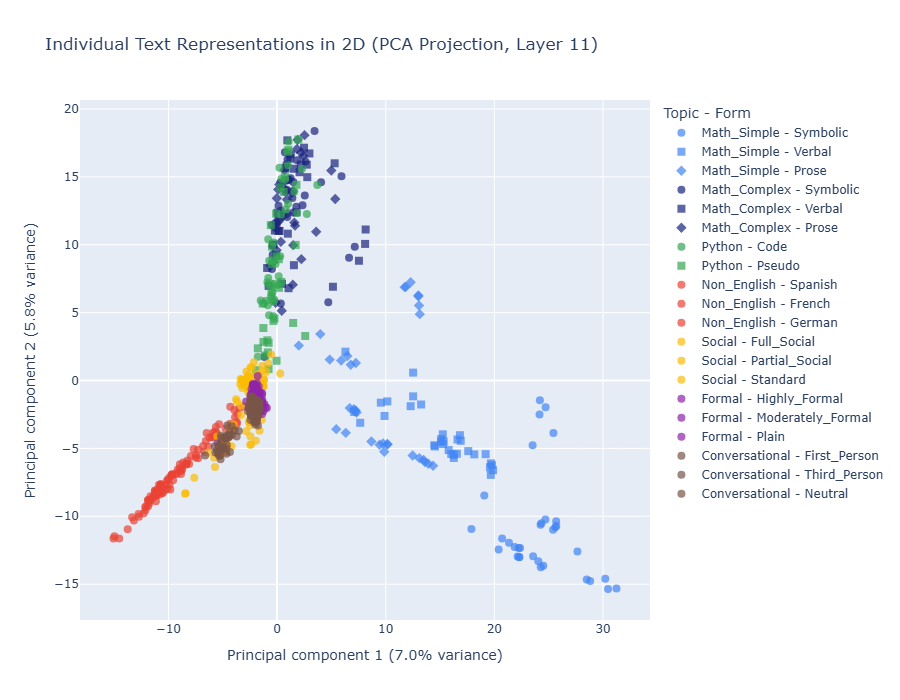
The permutation test confirmed this difference is highly significant (p < 0.0001). The observed difference between within-topic and cross-topic similarity (0.366) exceeded all 10,000 permuted values, indicating that topic-based clustering is not an artifact of chance. A review of the cosine similarities between all topic + form pairs is shown in Figure 11 and the clustering of each individual text sample, coded by topic + form is shown in Figure 12.
Figure 11: Full Part 2 cosine similarity matrix
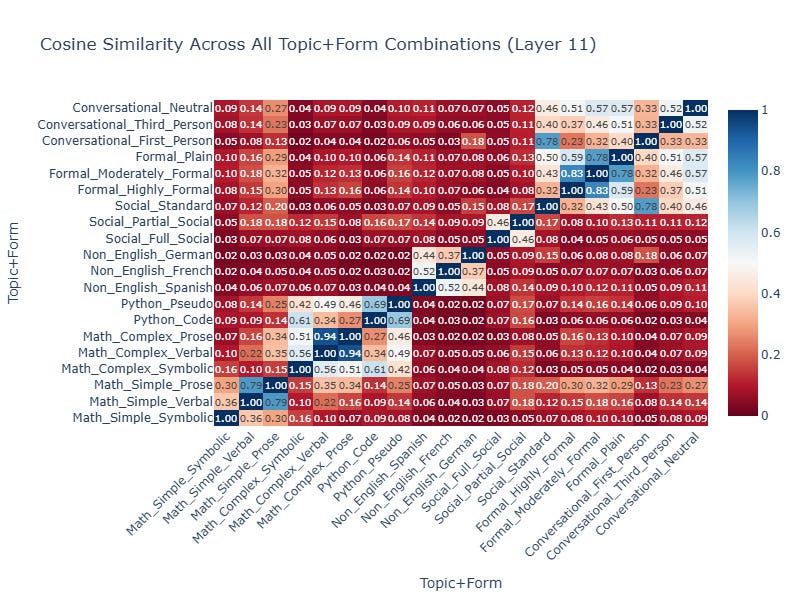
Figure 12: Part 2 PCA analysis showing concentration for text samples within each topic + form pairing
Interpretation
This finding presents a striking contrast to H1 and H2. While the most active features respond to surface syntax (H1 supported, H2 supported), the model’s overall representational geometry organizes by semantic topic (H3 not supported).
One possible interpretation consistent with these findings is a two-tier representational structure: highly-activated specialist features act as syntactic detectors, responding to specific surface markers like mathematical symbols or Python keywords. But beneath this syntactic surface layer, the broader pattern of activation across thousands of features preserves topic-relevant information. The model simultaneously “notices” that input contains mathematical symbols (activating syntax-specific features) while also representing it in a region of activation space shared with other mathematical content regardless of surface form. Here, “topic” should be understood as a coarse, human-defined proxy for semantic content, not evidence of grounded or task-usable meaning.
The degree of within-topic clustering shown in the scatter plot above also varies in revealing ways. Topics with subtle surface differences - Conversational (First_Person, Third_Person, Neutral) and Formal (Highly_Formal, Moderately_Formal, Plain) - form tight clusters in the PCA projection, with forms nearly overlapping. In contrast, topics with dramatically different surface forms - such as Math_Simple (Symbolic vs. Verbal vs. Prose) and Python (Code vs. Pseudocode) - show looser clustering, with forms spreading further apart despite remaining closer to each other than to other topics.
This gradient reinforces the two-tier interpretation: the model’s overall representational space organizes by topic, but within each topic cluster, surface form still influences positioning. The more distinctive the syntactic markers that differentiate forms, the greater the within-topic spread. Topics whose forms differ only in register or word choice cluster tightly; topics whose forms differ in character sets, symbols, or syntax cluster more loosely while still remaining grouped by topic.
H4: Model accuracy on mathematical completion tasks will correlate with specialist activation strength.
The final hypothesis sought to connect the interpretability findings from H1-H3 to observable model behavior. If the specialist features identified in earlier analyses contribute meaningfully to mathematical competence, inputs that activate them strongly should yield better performance on mathematical completion tasks.
Methodology
The model was prompted to complete mathematical expressions presented in each surface form (symbolic, verbal, prose). For example, given “8 - 3 =” the model would generate a completion, which was then evaluated against the expected answer. Accuracy was measured across all three surface forms to test whether the form-sensitivity observed in specialist activation (H1) translates to form-dependent performance differences.
Results
The results are inconclusive—not because the hypothesis was falsified, but because GPT-2 Small lacks the prerequisite capability to test it. The model achieved near-zero accuracy across all surface forms, as shown in Figure 13.
Examination of the model’s outputs revealed repetition patterns rather than mathematical computation. GPT-2 Small does not perform arithmetic reasoning; it engages in pattern matching based on its training distribution. Without a baseline level of mathematical competence, no meaningful correlation between specialist activation and performance can be established.
Interpretation
H4 cannot be evaluated with this model. Testing whether specialist features causally contribute to mathematical performance would require a model that demonstrates genuine mathematical reasoning capability—such as larger language models or models specifically trained on mathematical tasks.
GPT-2 Small’s inability to do math does not diminish the H1-H3 findings, which characterize how the model represents mathematical content internally; it simply means we cannot yet determine whether those representational patterns have behavioral consequences. More importantly, it yields an important insight related to model safety: that internal organization (as demonstrated in the results for H1-H3) does not equate to model capability. A conflation of these elements risks overestimating model capabilities in ways that risk unreliable or dangerous model output.
VI. Implications and next steps
The aforementioned Part 2 analysis, while broadly affirmative of the key takeaways provided for non-technical stakeholders in Part 1 of this series, nonetheless provides interesting and useful nuance as to how those key takeaways may be implemented.
Implications for key stakeholders
For end users of AI models:
Part 1 of this analysis suggested that the model’s “understanding” of a topic, if present, is distributed across many features, rather than localized in single interpretable units. The practical implication of this hypothesis was a warning that a model’s ability to provide useful outputs may depend on the prompt’s surface form. Two prompts with the same meaning may generate very different results - with widely varying levels of usefulness - when those prompts use different surface forms.
In Part 2, we both validated this hypothesis and examined possible root causes, finding that the model processed different surface forms of equivalent meaning via distinct feature subsets, activating different specialist features.
In light of this, the practical risk management strategies suggested in Part 1 remain:
Vary inputs to probe for brittleness and test edge cases. As clearly shown in the Part 2 analysis, varying inputs - even slightly - can result in dramatically different outcomes. This reinforces the need for rigorous testing of model performance across surface forms and in edge cases.
Verify outputs independently for consequential decisions. The aforementioned variability is but one source of response variability which means that human review in critical use cases (healthcare, law, governance, financial markets, etc.) remains and will continue to inhibit the potential benefit associated with greater model adoption.
For business leaders:
Part 1 of this analysis suggested that, given the unpredictable nature of model outputs in response to even minor variations in input surface form (among other attributes), models are still not ready for widespread deployment without retaining a human-in-the-loop architecture. This remains doubly true for sensitive use cases.
Part 2 in this series reinforced that perspective, emphasizing the need for testing and validation to incorporate format variation. A model tested exclusively on symbolic mathematical notation (e.g., “2+2=4”) may behave unpredictably when users provide equivalent content verbally (e.g., “two plus two equals four”) - not because the model lacks relevant capability, but because it processes these inputs through different pathways. While surface form variation is already considered best practice in ML Ops and eval set design, this analysis provides concrete mechanistic evidence for why those processes remain critical to ensuring safe deployment of AI systems.
For regulators:
Part 1 of this analysis strongly advocated for continued emphasis on AI safety techniques including, but not limited to, the types of mechanistic interpretability explored in this analysis. The rapid development and widespread deployment of larger, more complex, and more capable models continues to outpace our ability to understand those models’ most basic logical operations, resulting in a widening gap between model capability and our ability to control those capabilities.
Part 2 of this analysis builds upon that message in two ways. First, the finding that models process semantically equivalent inputs through different neural pathways - potentially producing different outputs - suggests that current evaluation and disclosure standards may be inadequate. Accuracy metrics reported on standardized benchmarks may not generalize to real-world usage, where users express equivalent intent in varied surface forms. Regulators should consider requiring deployment disclosures to include not just overall performance metrics, but explicit characterization of known format sensitivities and the range of input formats over which performance claims are validated.
Second, the inconclusive H4 results highlight a fundamental gap in the current state of interpretability research: characterizing how models represent information internally does not necessarily mean we can predict whether those representations will produce reliable behavior. This gap has direct implications for regulatory reliance on interpretability-based safety audits. Until research matures to reliably connect internal findings to behavioral outcomes, regulators should treat interpretability analyses as informative diagnostics rather than sufficient evidence of safety. Certification frameworks that depend on “explainability” requirements should acknowledge this limitation explicitly.
Finally, bridging this gap between interpretability and behavioral prediction is unlikely to emerge from commercial incentives alone. Given that model developers’ revenue is most directly influenced by developing ever more powerful and complex models, the gap between model capability and our ability to control those capabilities is likely to widen absent regulation and additional research that serves the public interest. This analysis adds to the case for sustained public investment in AI safety research, particularly work that connects mechanistic findings to real-world model behavior.
Next steps for research
The Part 2 analysis raises several questions that merit further investigation.
Understanding the two-tier structure
The H1/H2 findings specialist features respond to surface form and the H3 findings that overall representations cluster by topic suggests the model may utilize a layered representational architecture. The most strongly-activated features act as syntactic detectors, but semantic coherence must be encoded somewhere. One hypothesis could be that meaning resides in the “long tail” of less-active features: individually modest activations that collectively preserve topic-level organization even as the most salient features respond to surface syntax. Testing this hypothesis would require analyzing how much of the topic-clustering signal (observed in H3) persists when high-activation syntactic specialists are removed from the representation, and whether the remaining features exhibit more form-invariant, semantically-coherent patterns.
Feature steering experiments
The analyses in this series have been observational: measuring which features activate in response to various inputs. A more direct test of whether these features causally influence model behavior would involve artificially activating (”clamping”) specific features and observing the effect on outputs. Anthropic’s “Golden Gate Claude“ experiment demonstrated this approach, amplifying a feature associated with the Golden Gate Bridge and observing the model’s resulting fixation on that topic. A similar approach applied to the syntactic specialists identified here could reveal whether these features merely correlate with input patterns or actively shape model computation. For example, clamping a feature associated with exponentiation while prompting the model with “what is two plus two?” might bias the output toward “22“, as opposed to simply answering “4”. Such a response would serve as evidence that the feature influences the model’s mathematical interpretation, not just its pattern recognition.
Scaling to more capable models
Finally, this analysis was conducted on GPT-2 Small, a model with 124 million parameters that lacks genuine mathematical reasoning capability. Whether the patterns observed here - surface-form sensitivity in specialist features, topic-based clustering in overall representations - persist in larger, more capable models remains an open question. It is possible that the threshold for truly conceptual (rather than syntactic) feature emergence occurs at larger scales; alternatively, the two-tier structure may be a fundamental property of how transformer-based language models organize information. Extending this analysis to models like GPT-2 XL, Llama, or open-weight versions of more recent architectures would help distinguish between these possibilities.
Many thanks to Jim Dabell and Will Henry for their generous feedback on a draft of this article.